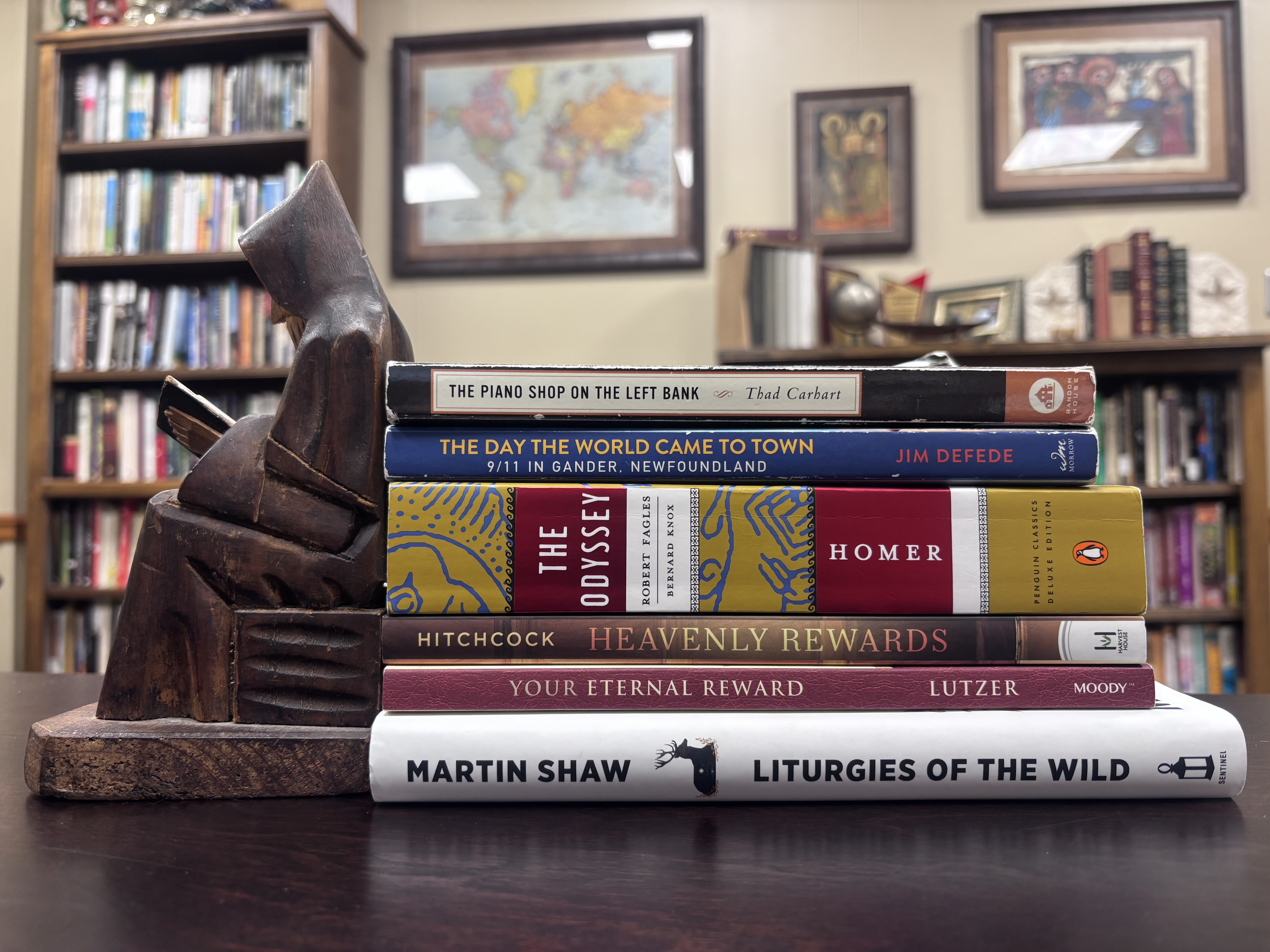
Here’s the 6 books I read in August. This brings my 2026 total to 59 books. I’ve provided Amazon affiliate links for each book. Happy reading!
(I must always clarify that I read many books with which I disagree. I learn the most by reading things that do not represent my position.)
The Piano Shop on the Left Bank: Discovering a Forgotten Passion in a Paris Atelier by Thad Carhart
Just a beautiful book. It’s not for everybody. But it’s for me. Walking his two young children to school every morning, Carhart passed a little French piano shop. One day he entered and fell in love with pianos – piano people, piano history, and piano design. This book has lots of piano. It’s a splendid memoir about a place and a subject of which I know nothing. These are two ingredients for books which peak my interest. On top of that, it is superbly written.
The son of an Air Force officer, Thad Carhart grew up in a variety of places, including Washington, D.C.; Fontainebleau, France; Minneapolis; Amherst, Massachusetts; and Tokyo. After graduating from Yale, he worked for the State Department as an interpreter.
I picked this one up at a Little Free Library after an early morning run. Delightful read. Never pass a stack of books. Always look! When 38 planes bound for the United States were forced to land in Gander, Newfoundland on September 11, 2001, the people of this small community demonstrated hospitality to thousands of stranded travelers. Its a glimpse of when humans get it right. Boy, do we need more stories like this one.
DeFeded is an award-winning journalist who was a staff writer for the Spokesman Review in Spokane, Washington, and the Miami New Times, before becoming a metro columnist for the Miami Herald.
The Odyssey by Homer
I spent the bulk of the month with this ancient epic poem. I’d never read the poem in full but I was very familiar with the overall storyline and many key passages. My motivation was to read the book before seeing Christopher Nolan’s film adaptation. I did not accomplish that goal. I read about 200 pages when I saw the movie. I finished the remaining 300 pages afterward.
I did not love the Fagles’ translation (that’s a ridiculous statement given that I’ve never read the original Greek!). The passages I knew of the Odyssey were from the Fitzgerald translation, which is far more poetic than Fagles somewhat stilted prose. Here is a great example from what I think is the best line in the poem:
Fitzgerald Translation:
“So she too rejoiced, her gaze upon her husband, her white arms round him pressed as though forever.”
Fagles Translation:
“So joyous now to her the sight of her husband, vivid in her gaze, that her white arms, embracing his neck would never for a moment let him go …”
“Pressed as though forever” is a superior line and one that haunts my imagination. If you’ve never read The Odyssey, go watch the movie and then pick up the book.
Fagles (1933-2008) was Professor of Comparative Literature, Emeritus, at Princeton University. He was the recipient of the 1997 PEN/Ralph Manheim Medal for Translation and a 1996 Award in Literature from the American Academy of Arts and Letters. His translations include Sophocles’s Three Theban Plays, Aeschylus’s Oresteia (nominated for a National Book Award), Homer’s Iliad (winner of the 1991 Harold Morton Landon Translation Award by The Academy of American Poets), and Virgil’s Aeneid.
Heavenly Rewards: Living with Eternity in Sight by Mark Hitchcock
The next two books were read as research for a pastor’s conference I led in Nicaragua in September titled, “The Pastor’s Reward: Three Heavenly Crowns for Faithfulness.” I was hesitant to cover this topic because I’m in disagreement with much that is said regarding rewards. Much of the reward talk dances near the line of distorting the gospel by placing the focus upon the work of man rather than the completed and sufficient work of Jesus. I find that it leads many people to lean toward works rather than grace. My conference attempted to place reward passages into the proper context of the Christian story as a whole and the gospel story in particular.
Hitchcock’s book is built around what he calls the Reward Principle or the Law of Rewards: The life you live today will determine your life in eternity. At many points it did make me uncomfortable. Rewards can be emphasized to such a degree that heavenly rewards become a greater reward than a relationship with Jesus. That would be a dangerous error. Hitchcock does not reach that error but I fear many of his readers will.
Hitchcock serves as senior pastor of Faith Bible Church in Edmond, Oklahoma and is also an Associate Professor of Bible Exposition at Dallas Theological Seminary.
Your Eternal Reward: Triumph and Tears at the Judgment Seat of Christ by Erwin Lutzer
Of the two books on reward on this log, I prefer Lutzer’s work. Yet, there would still be much disagreement. His thesis: the person you are today will determine the rewards you will receive tomorrow. He argues that those who are pleasing to Christ will be generously rewarded; those who are not pleasing to him will receive negative consequences and a lesser reward.
This is not the way I would frame the narrative. It puts to much focus upon us. I’d prefer: The more you seek Jesus; the more you will come to know him. The more you come to know him, the more you will love him. The more you love him, the more you will obey him. Our faithfulness to Jesus will be rewarded. Yet, there is no greater reward than abundant life with Jesus now and eternal life with Jesus to come soon.
Lutzer is pastor emeritus of The Moody Church in Chicago where he served as the Senior Pastor for 36 years. A respected theologian, Dr. Lutzer earned his BTh from Winnipeg Bible College, a ThM from Dallas Theological Seminary, a MA in philosophy from Loyola University, and an honorary LLD from the Simon Greenleaf School of Law.
Liturgies of the Wild: Myths That Make Us by Martin Shaw
I had high hopes for this one. Yet, it fell flat. I love discussion of myth. If you’re unfamiliar with the discussion, dig into CS Lewis and JRR Tolkien’s work on myth and how Jesus is the true myth. I firmly believe that stories shape us. We are shaped by stories passed down by family and stories alive in our community. Some are shaped by stories in books, TV, and movies. Yet, Christians live out of the Christian story -the true story of God’s rescue plan to save sinners like you and me.
Shaw’s book was a lengthy discussion on myth but I found it far too vague. There was lots of spiritual talk without spiritual substance. There is just not enough Jesus to hold on to here.
Shaw is a writer and teacher who lives on Dartmoor. He is founder of the Oral Tradition and Living Myth courses at Stanford University, he is also director of the Westcountry School of Myth in the UK. He is Reader in Poetics at Dartington Arts School. Shaw has spent twenty years as a wilderness rites of passage guide, working with returning veterans, at-risk youth and hundreds of others to establish a deep connection to nature through a four-day fast in a wild place.

