Here’s the 7 books I read in June. This brings my 2026 total to 45 books. I’ve provided Amazon affiliate links for each book. Happy reading!
(I must always clarify that I read many books with which I disagree. I learn the most by reading things that do not represent my position.)
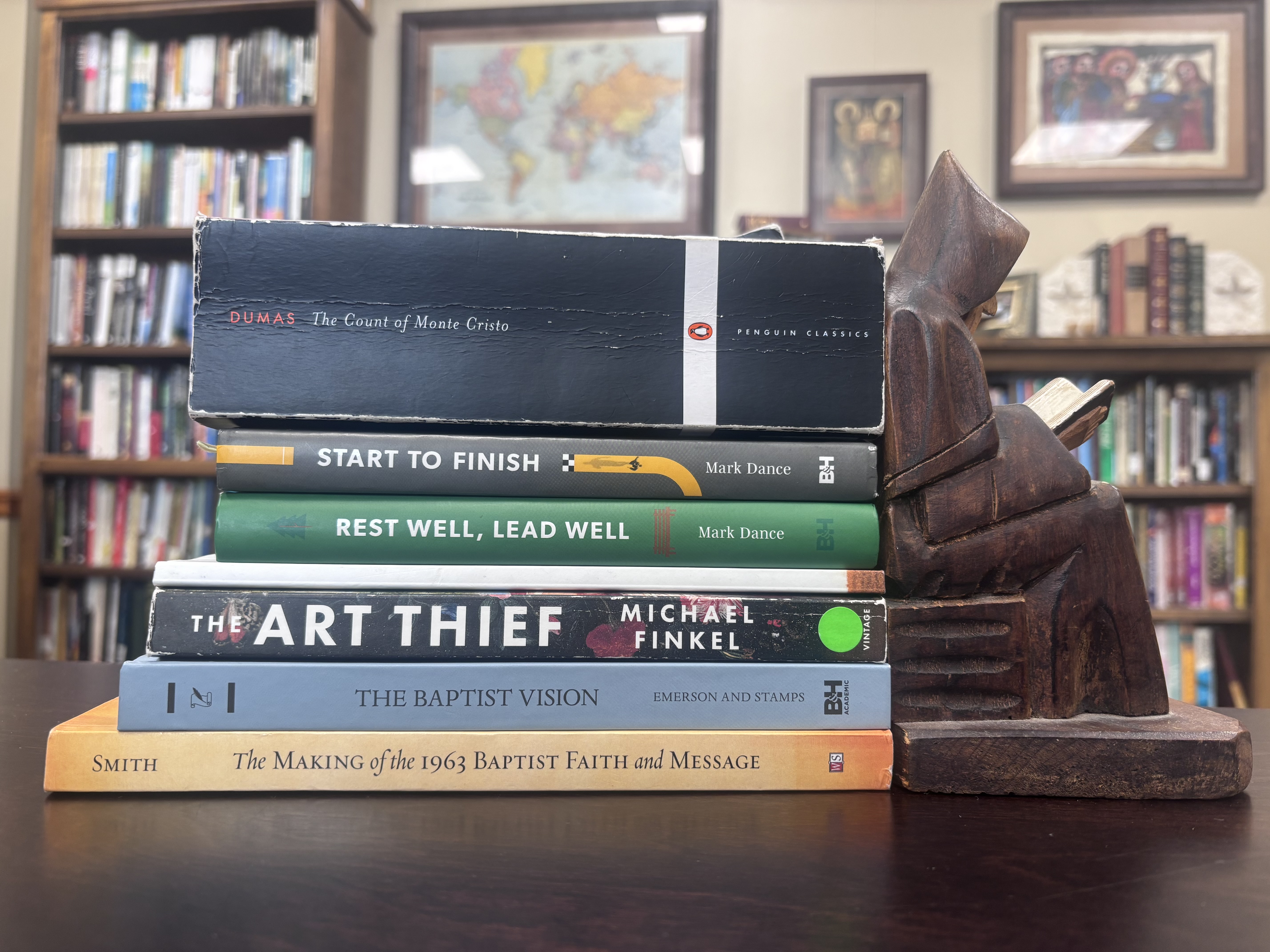
The Count of Monte Cristo Alexandre Dumas
I read the first 1,000 pages during my family vacation at the end of May. It took me another three weeks to finish the final 243 pages as I was bogged down in the twist and turns of dozens of subplots. The website LitCharts was a constant companion during the final stretch aiding me in keeping the characters and storylines in order.
This work is often abridged – for good reason. The book is not too long. It’s uneccesarily complicated. The book is beloved because we resonate with the basic theme of a desire for revenge. Some of us have learned that revenge does not satisfy. Others will learn in time.
Dumas’ most successful novels are The Count of Monte Cristo which appeared in 1844 and The Three Musketeers published in 1844. He also wrote travel books, children’s stories and his Memoires, which describe his early life, Parisian literary circles, and the 1830 revolution.
Start to Finish: The Pastor’s Guide to Leading a Resilient Life and Ministry by Mark Dance
I purchased this book alongside Dance’s book on Sabbath that follows. I figured it would be best to read them as a pair. This volume is billed as a pastor’s guide to ministry but it more of an extended exposition and application of the greatest commandment – to love God and love neighbor.
The book’s biggest contribution is my reflection on this portion:
Can pastors have friendships in the churches they serve in? When I became a pastor, the conventional wisdom among ministers was that a pastor should not become friends with church members. It was an understood assumption. It was talked about openly, and for the most part, went unchallenged.
At first, I bought into this line of reasoning. Part of me liked the us-and-them mentality because it made me feel superior. A larger part of me resented it because I wanted to be an intimate part of the faith family I was leading. Whether you are a pastor or a lay leader in your church, I urge you not to confuse friendship with favoritism. Otherwise, you are vulnerable to the isolation trap. Your church is more than your job, they are your family.
Mark Dance is the executive director of the Arkansas Baptist State Convention. He pastored and planted churches for thirty years and led pastoral ministry initiatives at Lifeway and GuideStone for over a decade.
Rest Well, Lead Well: Why Sabbath Matters to Your Ministry by Mark Dance
This is a fantastic work. I’ve read dozens of book on Sabbath. This little volume will float to the top of my recommendations. I will return to it often. It is simple but helpful. It begins with the crucial theological point of Sabbath as a person – Jesus Christ. It moves onto Sabbath as gift and command. It also includes Sabbath sabotage, a sustainable pace, and a chapter on making tough decisions. I’m personally thankful for the appendix on sabbaticals. Pastors need to navigate the tension between being highly motivated and terminally driven. Dance highlights that many have failed to discern between denying themselves and neglecting themselves. Ouch.
Obey the Sabbath: Rest in Christ by Blake White
I returned to this volume as I prepared to preach Jesus’ statement, “I am Lord of the Sabbath.” White walks readers through the foundational issues related to the Sabbath command, then briefly examines all the key biblical passages related to the Sabbath and its fulfillment in Christ.
White makes an interesting and intricately argued point in 69 pages: Christians are not bound to the Sabbath command. He also declares that the Sabbath was never changed by God from Saturday to Sunday. The book is built on the foundation that Christians are not bound to the Old Covenant Law, including the command to work six days and rest on Saturday. The seventh day of creation and the Sabbath command pointed forward to something greater. They pointed to Jesus, who alone brings true rest. In the New Covenant, to obey the Sabbath is to trust in King Jesus.
Blake White is the Lead Pastor of South Side Baptist Church in Abilene, Texas.
The Art Thief: A True Story of Love, Crime, and a Dangerous Obsession by Michael Finkle
Oh boy, do I love this type of book. It details the crimes of Stéphane Bréitwieser, the most prolific art thief of all time. He pulled off more than 200 heists, often in crowded museums in broad daylight. But he was not a sophisticated, professional thief. He grabbed art and stuffed priceless pieces into his shirt or pants. He then displayed the art in his attic room, for he still lived at home with his mom. If you like this one, you should also read The Falcon Thief: A True Tale of Adventure, Treachery, and the Hunt for the Perfect Bird by Joshua Hammer.
Michael Finkel is the author of “The Art Thief,” “The Stranger in the Woods,” an international bestseller, and “True Story,” which was adapted into a 2015 motion picture starring James Franco and Jonah Hill. He has reported from more than 50 countries and written for National Geographic, GQ, Rolling Stone, Esquire, Vanity Fair, The Atlantic, and The New York Times Magazine.
I’ve been reading books on Baptists and Baptist history because I firmly believe that Baptist polity has fallen out of favor. Historic Baptist institutions and conventions are throwing aside baptist polity for personal preferences. It’s tragic.
This is a very helpful volume. It breaks the Baptist vision into three parts: foundations, distinctives, practices. It limits the discussion on distinctives to liberty of conscience, believer’s baptism, a believer’s Congregational church, covenantal communion, and religious liberty. Emerson and Stamps excel at placing Baptists inside of their particular lane in wider Christian history and the wider Christian family.
Matt Emerson holds a PhD in Biblical Theology from Southeastern Baptist Theological Seminary in Wake Forest, NC and is a member of the Evangelical Theological Society, the Institute of Biblical Research, and the Society of Biblical Literature. He is Dickinson Associate Professor of Religion at Oklahoma Baptist University in Shawnee, Co-Executive Director for the Center for Baptist Renewal, and co-editor for the Journal of Baptist Studies, and serves as a committee member for the Scripture and Hermeneutics Seminar.
Lucas Stamps serves as Professor of Christian Theology and Director of the Masters Programs at Clamp Divinity School, Anderson University (SC). He also serves on the board of directors for the Center for Baptist Renewal.
The Making of the 1963 Baptist Faith and Message by AJ Smith
This is the gem of this month’s book log. I was surprised that a dissertation-turned-book could be so captivating. I was truly sad when I finished it. I took it slow, but I wish I took it slower.
Questions regarding the orthodoxy of Dale Moody and Ralph Elliott propelled the Southern Baptist Convention (SBC) toward a re-evaluation of its doctrinal statement, the Baptist Faith and Message (BFM). The SBC adopted this document in 1925 under the leadership of E. Y. Mullins. In this book, Smith argues argues that the 1962 Committee on Baptist Faith and Message produced a document that expressed subtle shifts in Baptist theology. He details the work of the committee and looks at those persons and groups who influenced the outcome of the work. He cites minutes from the committee to highlight those who argued for specific changes or additions.
A. J. Smith is Associate Pastor for Worship and Administration at Seven Springs Baptist Church, Calera, Alabama, and an Adjunct Professor of Church History for Liberty Theological Seminary’s Distance Learning Program. He taught at Simmons College of Kentucky from 2004 to 2006 and has spoken before professional societies on Baptist history, systematic theology, and patristic theology.

