Here’s the 8 books I read in February. This brings my 2026 total to 19 books. I’ve provided Amazon affiliate links for each book. Happy reading!
(I must always clarify that I read many books with which I disagree. I learn the most by reading things that do not represent my position.)
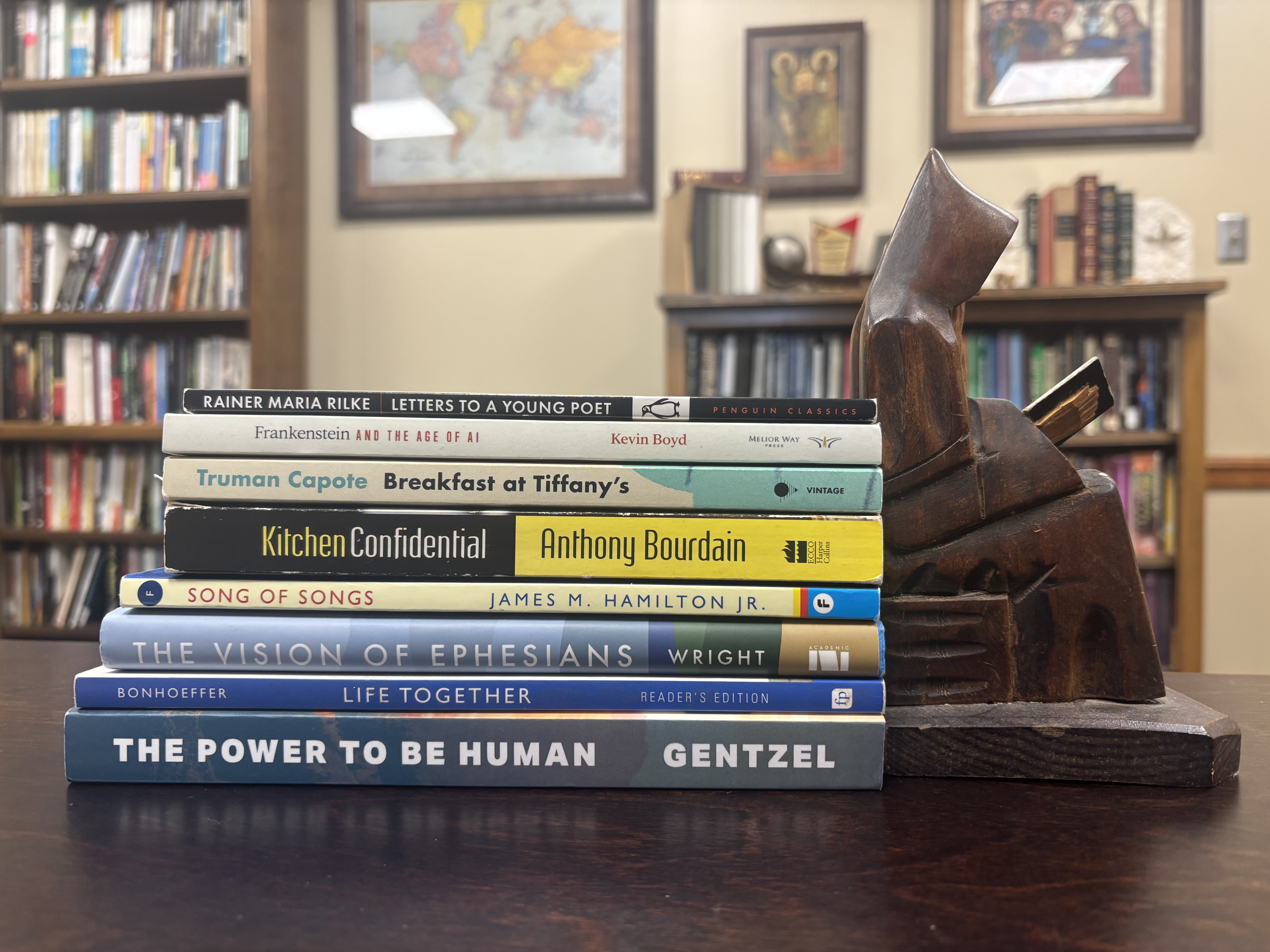
Letter to a Young Poet by Rainer Maria Rilke
I have many unwritten books floating on a constant wave in my brain. One is a collection of letters written to a Christian throughout his life of faith. In an effort to get inspired to work on this book idea, I purchased Rilke’s epistolary work. You gotta start somewhere. In this volume, Rilke writes a series of letters to a young officer advising him on books, writing, love, suffering, and more. The book also contains “Letter from a Young Worker,” a fictional letter written near the end of Rilke’s life as an argument against Christianity.
Rilke is widely recognized as one of the most lyrically intense German-language poets
Breakfast at Tiffany’s by Truman Capote
My wife took a trip to New York City in early February. I asked for two gifts: 1) a print of Van Gogh’s “Self Portrait with Hat” from the Met and 2) a copy of Breakfast at Tiffany’s from a NYC bookstore. My lovely wife delivered on both requests. The Van Gogh is perfect. The Capote? Not so much. Breakfast at Tiffany’s is thin on character development and even thinner on plot. Entertaining? Absolutely! But you’d be better off reading The Great Gatsby. In case you’re wondering, Breakfast at Tiffany’s is nothing like the Audrey Hepburn movie. This is a rare case in which the movie is far superior to the book. Skip this Capote work and go to In Cold Blood, which has one of my favorite lines: “He was the smartest person I ever come across. A human library. When that boy read a book it stayed read.
Capote was American novelist, short-story writer, and playwright whose early writing extended the Southern Gothic tradition.
Kitchen Confidential: Adventures in the Culinary Underbelly by Anthony Bourdain
This was another find in my local Little Free Library. It is crass and raunchy in parts but it is a beautiful example of memoir. Bourdain takes you on a tour of the culinary underbelly off limits to restaurants goers like you and me. But he lets us get a peak into the kitchen and introduces us to a cast of characters and a wild way of life.
Bourdain was an American chef, author, and television personality who helped popularize “foodie” culture in the early 21st century through his books and television programs.
Songs of Songs: A Biblical-Theological, Allegorical, Christological Interpretation (Focus on the Bible Series) by Jim Hamilton
The book almost has me convinced. I’ll need to read it another time. Hamilton argues that the Song of Songs is about “human love, but the hero of the Song is no common man. He’s the King of Israel, the son of David, and he is a Shepherd-King who has cultivated a garden-city, even as he overcomes the alienation and hostility between himself and his Bride to renew an Eden-like intimacy between them. The Song is about human love, and the son of David who is the King in the Song, is a type of the one who is to come.”
Hamilton details how Song of Songs is a song of hope which points us to the day when the curse will be rolled back, the land will have no more famines, and all will again be very good under the hand of the one who works and keeps the garden. It’s more than a love song. It should fill us with Messianic hope.
Hamilton is professor of Biblical theology at The Southern Baptist Theological Seminary and preaching pastor at Kenwood Baptist Church in Louisville, Kentucky.
The Vision of Ephesians: The Task of the Church and the Glory of God by NT Wright
I received this book as a Christmas present from my in-laws. Books always make the best gifts. Always. This is the newest release in Wright’s smaller volumes working through biblical books. I’ve previously read his volumes on Romans and Acts. This is the best of the three. More than any specific comment on Ephesians, I will remember this book for an illustration used regarding the various books of the Bible. Wright was asked in an interview, “So, Tom, what’s your favorite Pauline letter and why?” Wright had not prepared an answer for the questions but said,
“Well, where I live in Scotland there are many rooms in the house. There’s the kitchen, which gets very busy and hot and we all bump into one another but its where important things happen and we couldn’t do without it. That’s Galatians. Then across the corridor there’s a formal dining room with decent furniture and everything laid out properly. That’s Romans. Then there are living rooms and bedrooms which more or less correspond to the Corinthians letters. But, there’s a room at the back of the house, looking south across the Firth of Forth to the Lammermuir Hills forty miles away. If you look to the left, you can sometimes see the sun rising out of the North Sea. And if you look to the right, at the right time of the day, and the month, you can see the moon setting over the Lomond Hills. That’s Ephesians.”
Thus, Wright argues that Ephesians is a letter of vision.
Wright is one of the world’s pre-eminent New Testament scholars. A former bishop of Durham and the author of more than 80 books, he has taught at Cambridge, McGill, St. Andrews and Oxford Universities.
Life Together by Dietrich Bonhoeffer
bel·fry /ˈbelfrē/
Noun: the part of a bell tower in which bells are housed.
In January, I launched the Belfry, a book club offered to the ministerial staff of First Baptist Sulphur Springs. Life Together was an easy pick for the first selection. It has shaped my understanding of Christian community like no other book. I’ve read it perhaps a dozen times. It has been a blessing each time. It has been an even bigger blessing to share it with others. All other members of the Belfry were reading Life Together for the first time.
Bonhoeffer discusses community, the day together, the day alone, service, and confession. The chapter on confession is titled “Confession and the Lord’s Supper” but the conversation on the Lord’s Supper is just a few paragraphs.
The book is derived from Bonhoeffer’s common life that he and his seminarians experienced at the underground Finkenwalde Seminary. This community was unique. There is not a direct correlation between Finkenwalde and the modern-church but the modern-church needs to be challenged by such a model.
Bonhoeffer was a German Lutheran pastor, neo-orthodox theologian and anti-Nazi dissident who was a key founding member of the Confessing Church.
Frankenstein and the Age of AI: Making, Being Made, and The Hope of Becoming Human Again by Kevin Boyd
Two of my friend have written books on AI and I read them both this month. It’s a small (and strange) world. Kevin was a childhood friend of my wife. So I’ve had the pleasure of knowing Kevin for nearly 20 years and watching him grow to into an amazing pastor, leader, and writer. Beyond that, he’s a real deal family man.
This book is part analogy, part poetic, part prophetic.
Kevin uses the Frankenstein analogy to riff on the idea that making and being made are inseparable. Our inventions shape us even as we shape them. He does this with poetic flair. The chapters are short, punchy, but beautiful. Yet, there is no fluff. Kevin delivers the message with the full-throated proclamation of the prophet: If we forget what a soul is, we will soon forget how a soul is formed, and we will leave behind the One who formed the soul, to whom the soul belongs.
He does lot leave us without hope. The final chapter provides a path to become human again.
Kevin Boyd is the pastor of Legacy Church in Plano, Texas.
The Power To Be Human: Becoming Fully Alive in a World of Artificial Everything by Brent Gentzel
Brent released this book last year, but will soon release an updated version. I will read and purchase the updated version as well. I love to support my friends who bring books into the world.
Four years ago, Brent invited me into a small group of pastors who meet every year for a few days of fellowship and encouragement. It was been life-giving. I’ve been blessed and challenged by Brent’s wisdom, innovation, creativity, and pastoral heart.
He introduced me to AI long before it was a household concept. I first saw ChatGPT when Brent pulled it up and encouraged a group of pastors to explore it. My mind was blown. Brent has continued to use AI in fascinating ways for personal development and ministry. He’s well-aware of the benefit … and danger.
In The Power to Be Human, Brent argues were always on … but perhaps, not fully alive. Some of us fear that machines are becoming more human. But the real crises is that we’re becoming less human. Among other things, Brent walks through the power to create, love, overcome, connect, care, and change the world.
Brent Gentzel is the pastor of the First Baptist Church of Kaufman, Texas.
 Jeff Gravens