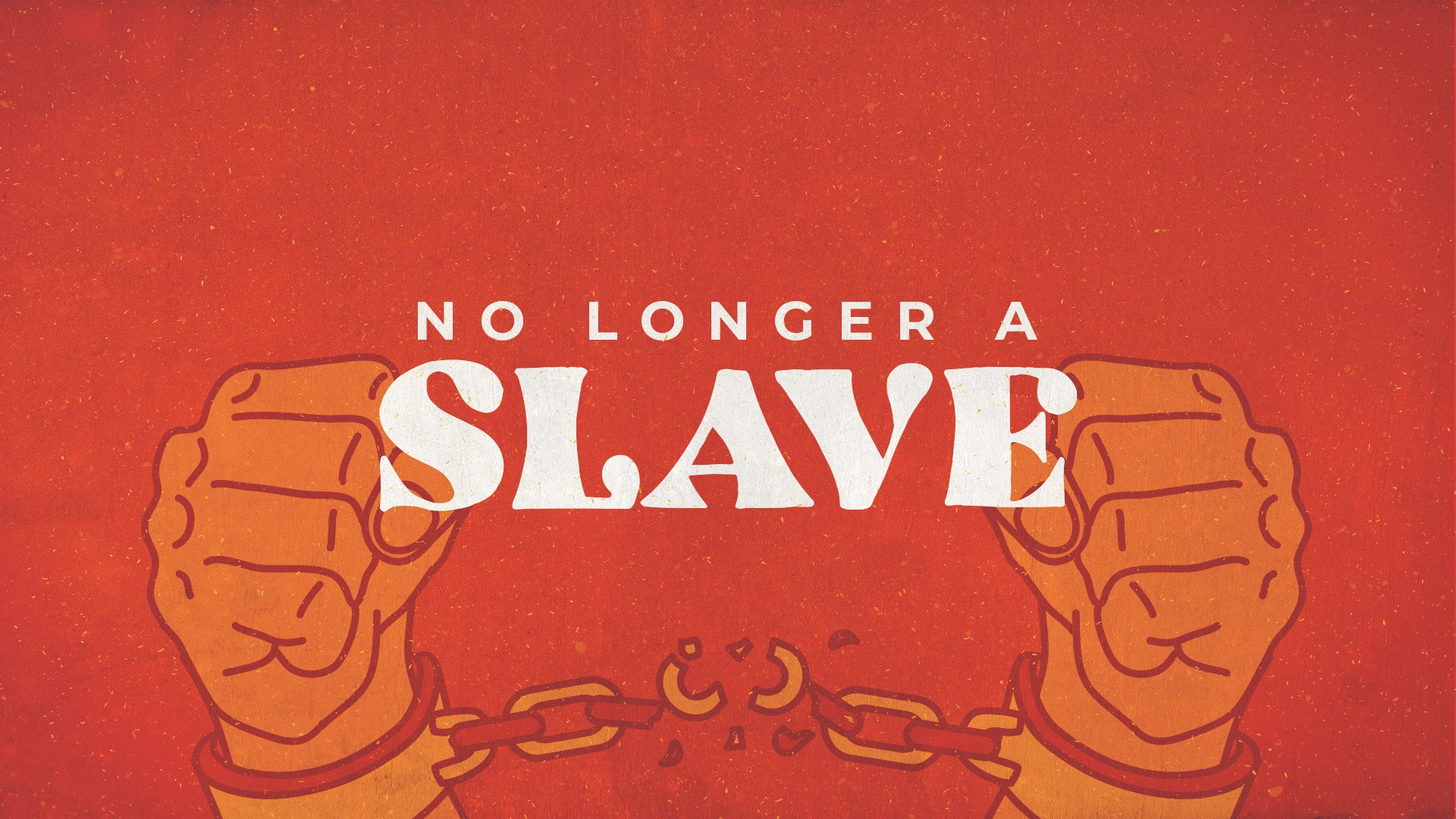
*Here’s is a slightly edited version of the first sermon in a series titled “No Longer A Slave” in a four week series over the book of Philemon.
Division vs Unity
We live in a day of outrage and division. Many seek reasons to be offended or make new enemies. Yet, our Christian faith calls us to unity. Jesus used a tax collector, a zealot, and fisherman as his first disciples. The church has been made up of diverse group of people called to unity ever since.
Jesus taught us to pray, “Your kingdom come, will be done, on earth as it is in Heaven.” I desire for Hopkins County to look more like Heaven as the citizens of Hopkins County become more like Jesus.
Philemon is a case study in Christian unity.
Philemon Introduction
[Take time to read Philemon]
Philemon is the shortest of Paul’s letters, only 335 words in the original Greek spanning a mere 25 verses. Most New Testament scholars believe Paul wrote Philemon while imprisoned in Rome in the early 60s.
Every New Testament letter is written within a specific context. Any reconstruction of the sequence of events referred to and implied in Philemon requires some interpretive decisions. Yet, the letter does provide some strong context clues:
- The slave, Onesimus, ran away from his master, Philemon (vv. 11, 18).
- As a runaway slave, Onesimus made his way to Rome and eventually encountered the ministry of Paul (v. 10).
- Onesimus became a Christian through Paul’s ministry and performed service for him (vv. 10, 13).
- Paul writes to restore the relationship between Onesimus and Philemon (v. 15).
- Paul wanted Philemon to accept Onesimus no longer as a slave but as a brother (v. 16).
Paul wrote to Philemon out of gospel conviction to unite Onesimus to Philemon in a demonstration of Christian unity. The gospel of Jesus transforms relationships and culture. In the light of the gospel, the institution and practice of slavery is shown to be darkness. Paul tackles this issue interacting with names he knows and faces he recognizes.
The Gospel Transforms Social Relationships.
There is neither Jew nor Gentile, neither slave nor free, nor is there male and female, for you are all one in Christ Jesus. – Galatians 3:28
For he himself is our peace, who has made the two groups one and has destroyed the barrier, the dividing wall of hostility – Ephesians 2:14
Philemon is a case study: Onesimus is no longer a slave but a Christian brother.
The Gospel Compels Reconciliation
Therefore, if anyone is in Christ, the new creation has come: The old has gone, the new is here! All this is from God, who reconciled us to himself through Christ and gave us the ministry of reconciliation: that God was reconciling the world to himself in Christ, not counting people’s sins against them. And he has committed to us the message of reconciliation. We are therefore Christ’s ambassadors, as though God were making his appeal through us. We implore you on Christ’s behalf: Be reconciled to God. God made him who had no sin to be sinfor us, so that in him we might become the righteousness of God. – 2 Corinthians 5:17-21
Therefore, if you are offering your gift at the altar and there remember that your brother or sister has something against you, leave your gift there in front of the altar. First go and be reconciled to them; then come and offer your gift. – Matthew 5:23-24
Philemon is a case study: two brothers divided must be united in Jesus name.
We Are Conduits of God’s Grace and Peace
We now briefly place a magnifying glass upon Philemon 1-3.
Paul begins this letter with a standard first-century letter opening: sender to recipient greeting. He identifies himself as “Paul, a prisoner of Christ Jesus.” Paul will allude to his own imprisonment throughout the letter. Paul lists “Timothy our brother” as a cosender of the letter.
Paul and Timothy write to “Philemon our dear friend and our fellow worker.” “Dear friend” is a rendering of a single Greek word which could be translated as “beloved.” “Fellow worker” identifies Philemon with other colaborers in the mission of taking the gospel to the world.
While Philemon is the letter’s primary recipient (he is the one addressed in vv. 4-20), Paul lists other recipients. “Apphia” is described only as literally “the sister.” Apphia is probably Philemon’s wife. Yet, it deserves noting that Apphia is mentioned apart from Philemon and there is no good reason to dismiss the possibility that Apphia held a leadership role in the church independent of Philemon. “Archippus” is described as a “fellow soldier” thus linking Archippus to the work being done by Paul and Timothy. Many who assume that Apphia is the wife of Philemon assume that Archippus is the son of Philemon and Apphia.
Lastly, the letter is addressed to “the church that meets in your house.” Paul has no intention of this letter to be seen as private – it has a wider audience. This is a church matter and church matters.
Paul’s conventional greeting arrives in verse 3: “Grace and peace to you.” The greeting of grace and peace is a favorite of the Apostle Paul. “Grace” is God’s unmerited favor towards sinners. Paul had experienced grace to a great extent. He correspondingly passes along the blessing. “Peace” is more than the absence of violence and hostility. For the Christian, peace is contentment in the face of any situation. Paul had experienced peace to a great extent. He correspondingly passes along the blessing.
“Grace and Peace” flow from “God our Father and the Lord Jesus Christ.” Paul knows he is not the source of the blessings – but he is a conduit. A conduit is a channel for moving water or a tube for protecting electric wiring. As Christians we are conduits for God’s grace and peace.
Conclusion
We are on the front porch of the letter. In verses 1-3 we’ve merely seen an introduction of names and a blessing. Seemingly insignificant, but gospel implications abound. Christianity is not lived in isolation. It is lived with the church and among the world. We rub shoulders with real people, with real names and faces. We are conduits for God’s grace and peace.
A few quick, practical points of applications:
Be quick to admit you’re wrong – to God and to people you’ve wronged. The mark of Christian maturity is humility and repentance.
Be quick to forgive – don’t hold grudges or quickly severe relationships. God doesn’t withhold forgiveness from you. You shouldn’t withhold forgivness from others.
Be quick to meet face-to- face – don’t rely on texts messages or heaven forbid, social media. Paul writes a letter (because of his own chains) but intends to visit Philemon’s house. People are that important. Reconciliation is that important.
Be quick to take breaks from social media. Perhaps is does you more harm than good. Perhaps you do more harm than good.
The gospel changes us from the inside out. When Jesus sits on the throne of your heart, it impacts everything.
The impact of the gospel should be evident in your heart and in your relationships.
 Jeff Gravens