Here are the 8 books I read in December. This makes my 2023 total 103 books. Be on the look out for my list of favorites of the year. It’s coming soon! Happy reading!
(I must always clarify that I read many books with which I disagree. I learn the most by reading things that do not represent my position.)
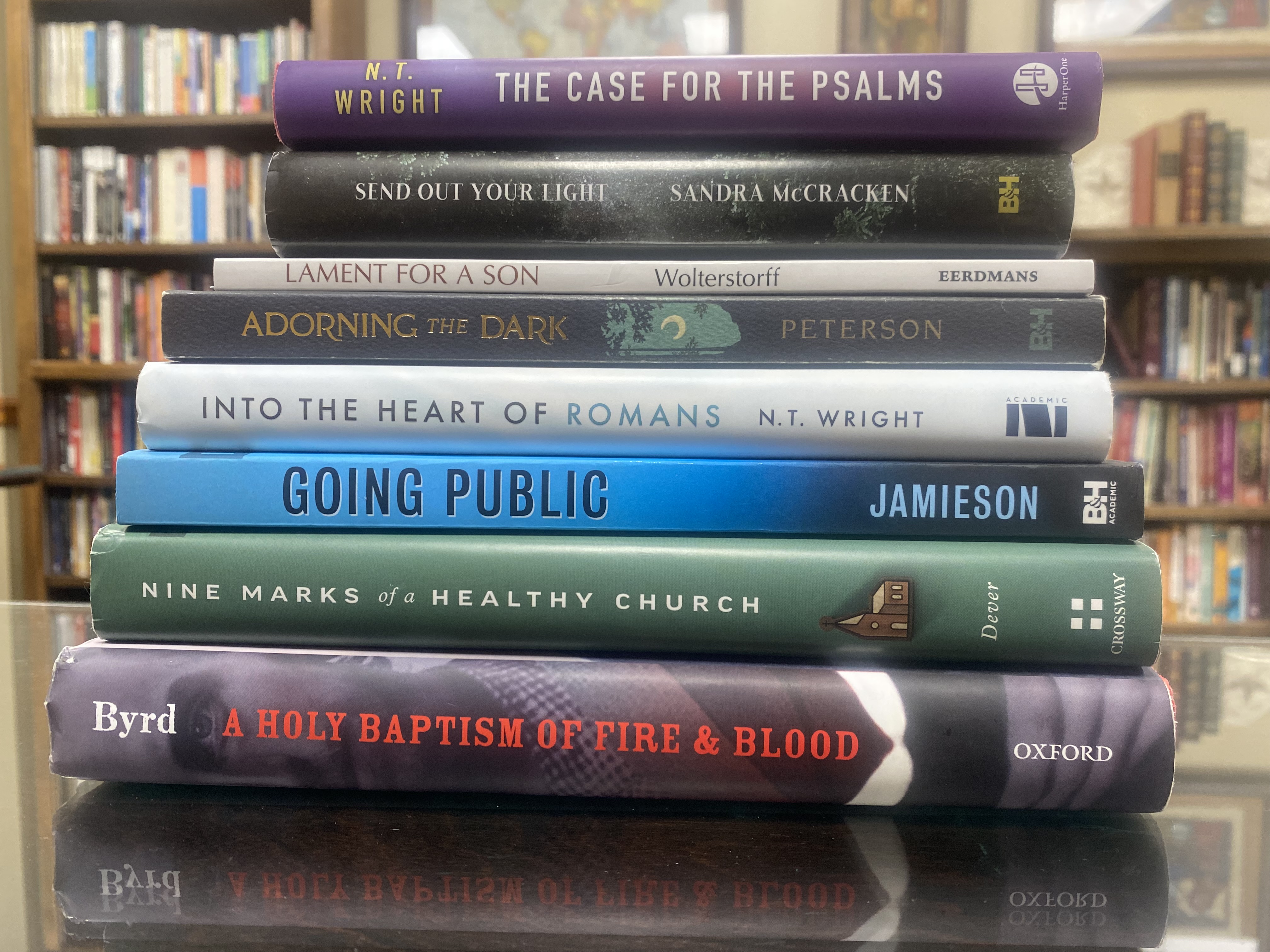
The Case for the Psalms: Why They are Essential by NT Wright
This is a reread. I picked it up after it was referenced in the McCracken volume listed below. NT Wright is a world renowned scholar. He’s written tons of thick theological tomes. Yet, this compact reflection is my favorite. It is a small book penned out of a love for the Psalms. Wright speaks as a scholar but speaks from a position of devotion. His love for God and his devotional reading of Scripture is evident.
Wright argues that from the the beginning of the church the Psalms were an essential part of worship. He goes as far as to refer to them as “the great hymnbook at the heart of the Bible” and the “daily lifeblood of Christians.” Yet, in modern Christian practices they are largely ignored. In the places in which they are still used they are “often reduced to a few verses” or used as “filler” pieces between portions of the worship service.
Wright fights against the common modern practice by walking through large themes found in the great hymn book and offering reflections and insights. You’ll find nothing provocative or controversial. Perhaps thats why this book is not widely known. You will find just what the subtitle states, a case for why the Psalms are essential.
Send Out Your Light: The Illuminating Power of Scripture and Song by Sandra McCracken
This is a slow walking memoir on the creative process. McCracken shares encounters and insights from Scripture and reveals how those truths impact her songwriting and make way into her songs. The type of book I devour in a sitting or two. This is now my third reading of this book. It is the second time I’ve read it this year! Even after I finished it, I kept it within arms reach and reread a number of portions. Some books you love to read and hate to finish. I’m always on the hunt for the next one but I’m always content to return to favorites.
Adorning the Dark: Thoughts on Community, Calling, and the Mystery of Making by Andrew Peterson
I appreciate Peterson as songwriter, non-fiction writer, fiction writer, and creator of community. I recently mailed him a copy of my book, Stained-Glass Disciples. It contained a simple note: “I’ve been blessed by your work. May you be blessed by mine.” Just my attempt to say “Thank you.”
This volume is part memoir of Peterson’s musical journey and part advice for those who create. It is a personal meandering through a variety of topics and life experiences. I love every page. Like the McCracken volume above, this is the second time I’ve read it this year!
Some books are like comfort food. Adorning the Dark is chicken fried steak and mash potatoes. Or a big bowl of ice cream.
Lament for a Son by Nicholas Wolterstorff
This is a beautiful work and will likely make it on my list of favorites of the year. It is comprised of journal entries lamenting the loss of Wolterstorff’s 25 year-old son in a tragic accident. It is raw and honest. It is also filled with insightful theological observations. The key sign of a great book: The desire to read it out loud to those around you. My wife heard a number of these pages while next to me in bed.
This is not the type of book you’d pass along to those suffering with grief. Rather, it’s the type of book you pass along to everyone, knowing that some will someday be devastated by loss.
Into the Heart of Romans: A Deep Dive into Paul’s Greatest Letter by NT Wright
This is the second Wright book on this list. I enjoy some of Wright’s work. Those which I enjoy – I really enjoy (like the book discussed above). I find other Wright works to be “meh.” Is that too harsh? Perhaps. I find his “meh” work to be confusing, not because I don’t understand, but because I long for him to be clear about what he believes.
This falls volume falls into the “meh” category. I really loved the premise. Wright argues that many read the book of Romans as if it is about “me and my salvation.” He believes the Roman Road to be much bigger and more significant. The rest of the book is filled with great information that more resembles a commentary than a book. I love commentaries. I love books. But it is hard for a single volume to be both.
Going Public: Why Baptism is Required for Church Membership by Bobby Jamieson
Jamieson argues for a biblical understanding of baptism and a particular interpretation of how baptism should function within the church. Beleiver’s baptism? Yes. Under the authority of the church? Yes. Required for church membership? Yes. Required for celebration of the Lord’s Supper? Yes. This argument will challenge those in church traditions which baptize infancts and those in traditional baptist churches.
From the book’s promotional material: Why is baptism required for church membership? Because church membership is a public affirmation of someone’s public profession of faith in Christ, and Jesus has appointed baptism as the means by which his followers publicly profess their faith in him. Why does this question matter? Because removing baptism from membership erases the line Jesus himself has drawn between the church and the world.
Nine Marks of a Healthy Church by Mark Dever
Familiar with 9Marks? If so, you’ll know the book’s content. If not, you need to know that Dever is not a fan of church growth models and methods. This books offers no quick fixes or formulas for success. It gives nine marks of a healthy church. Notice not “the” nine marks of a healthy church. But merely “nine marks.” They include: expositional preaching, gospel doctrine, a biblical understanding of conversion and evangelism, church membership, church discipline, discipleship, church leadership, practice o prayer, and practice of missions.
A Holy Baptism of Fire and Blood: The Bible and the American Civil War by James Byrd
In his Second Inaugural Address, Abraham Lincoln proclaimed that those on both sides of the Civil War “read the same Bible and pray to the same God, and each invokes His aid against the other.” Bryd shows, in great detail, how the Bible was frequently wielded as a weapon in support of both North and South. The book requires some patience – it is by no means a quick read. Bryd provides example after example of how a single passage or theme was used by both Union and Confederate soldiers and supporters.
 Jeff Gravens